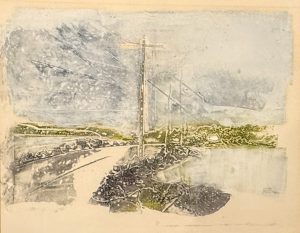

Frances Sumner Merritt
Frances Sumner Merritt’s story begins in Danvers, Massachusetts, where he was born in 1913 and first discovered a love for art that would shape his life. Eager to hone his craft, Merritt pursued studies at the Vesper George School of Art, the San Diego Academy of Fine Arts, the Massachusetts School of Art, and ultimately the Yale School of Fine Arts. His early years were marked by a passion for both making and teaching art, leading him to positions at Abbot Academy, Colby Junior College, Cranbrook Academy of Art, and Bradford Junior College, where he headed the art department.
Merritt’s journey took a transformative turn when he became Director of the Flint Institute of Art in Michigan. But it was in 1950, alongside his wife Priscilla, that he made his most enduring mark: founding and directing the Haystack Mountain School of Crafts in Maine. Under Merritt’s leadership, Haystack became a groundbreaking center for craft education, renowned for its spirit of experimentation and collaboration. He invited artists, craftspeople, and thinkers from around the world to gather in the tranquil setting of Deer Isle, Maine, fostering an environment where creativity and innovation could thrive.
Known for his quiet, supportive, and spiritual leadership, Merritt influenced countless artists and educators. He served as an exhibition juror, a panelist for the National Endowment for the Arts, and vice-chair of the Maine State Commission on the Arts and Humanities. He also collaborated with architect Paolo Soleri on the Haystack-Arcosanti project and was honored as a Fellow of both the American Crafts Council and the Royal Society of Art. Merritt’s own paintings and prints were exhibited at major institutions, including the Corcoran Gallery, the Portland Museum of Art, the Metropolitan Museum of Art, and the Museum of Modern Art.
Frances Sumner Merritt is significant for his visionary role in redefining craft education in America. His unique contribution was in creating a nurturing, international community at Haystack, where artists could experiment, collaborate, and push the boundaries of their disciplines. Through his leadership and his own artistic practice, Merritt helped shape the future of American craft, leaving a legacy that endures in the artists he inspired and the institution he built.
You can find works by Frances Sumner Merritt in several notable collections and venues:
National Gallery of Art, Washington, D.C.: The NGA holds multiple works by Merritt, including lithographs such as Super Power (1942), Victory Garden (1942), God is My Co-Pilot (1942), Labor Truce (c. 1941), and Maelstrom (1943). These works can be viewed through the NGA’s online collection or in person at the museum.
Portland Museum of Art, Maine: Merritt’s work has been exhibited at the Portland Museum of Art, reflecting his significance in Maine’s artistic community.
Metropolitan Museum of Art, New York and Museum of Modern Art, New York: Merritt’s art has been included in exhibitions at both of these leading institutions, underscoring his national reputation.
Hudson Museum: His work is also part of the collection at the Hudson Museum, further highlighting his reach in American art circles.
The Turtle Gallery, Deer Isle, Maine: This gallery represents Merritt’s work and provides biographical information, as well as access to available pieces and information on past exhibitions.
Auctions and Online Marketplaces: Merritt’s works, such as monotypes and prints, occasionally appear at auction houses like Thomaston Place Auction Galleries and on platforms like Invaluable, where you can find past and upcoming sales of his art.
Special Collections and Archives: The Francis Sumner Merritt papers, including documentation of his artistic and administrative career, are held at the Archives of American Art, Smithsonian Institution